▲


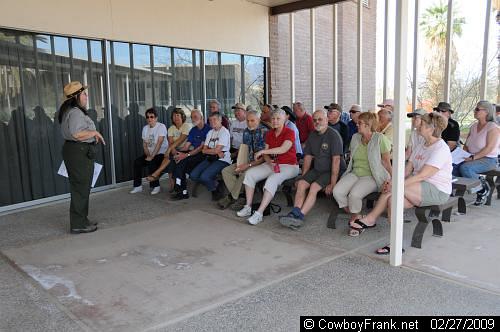
An interperative talk by National Park Service Ranger, Dianne Milliard
To many people, Borax and 20 Mule Teams are synonymous with Death Valley. What is borax and why was it so important to the development of the Death Valley National Park?
Listen in as Dianne explains this important compound.
See the bottom of this page for more details on borax.
 Listen, 34:37
Recorded, February 27, 2009 at the Death Valley National Park Visitor Center.
| National Park Ranger Dianne Millard | 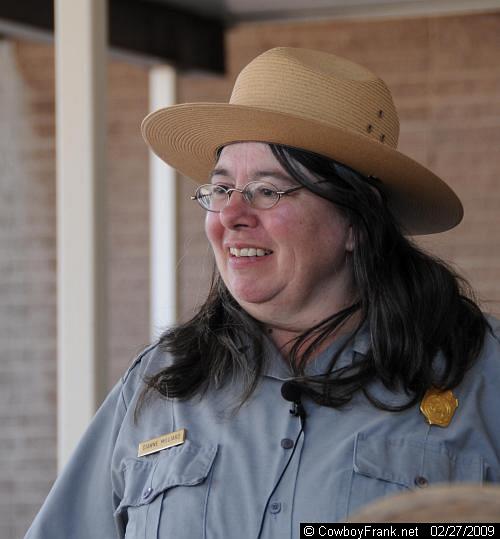 |
 | What most people think of when they hear Borax |
 |
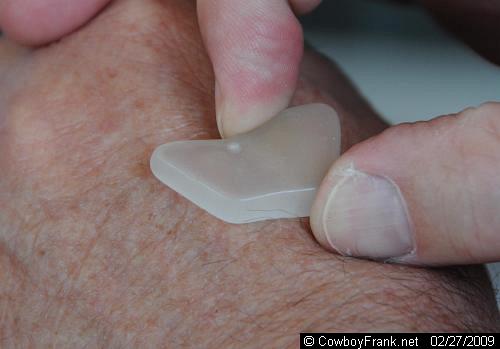 | One form of borax |
| Another form, Probertite | 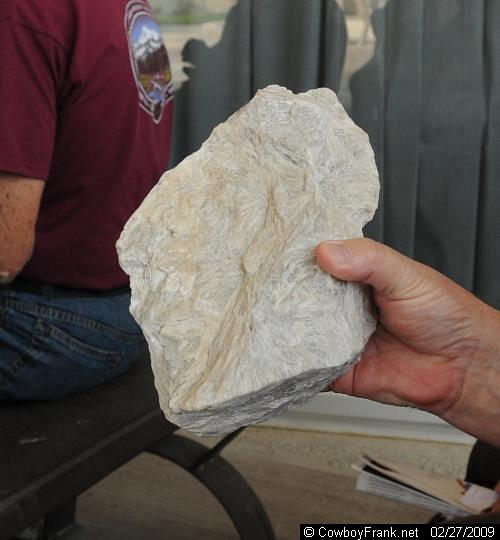 |
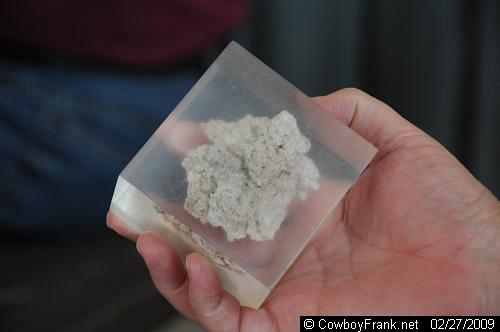 | And here we see ulexite or cottonball borax, the most common type found in Death Valley |
Borax changed the history of Death Valley.
It brought in an industry. It produced the famous 20 Mule Teams and it focused the world's attention on a great new mineral source, which, unlike the ephemeral gold and silver discoveries, was real. There were no "lost" borax mines.
The first form of borax to be found in the Valley was white crystalline ulexite called "cottonball", which encrusted the ancient lake bed, Lake Manly. Cottonball of this kind had been found earlier at Columbus Marsh and at Teel's Marsh, in western Nevada.
The first man to try to market Death Valley cottonball was an unsuccessful gold prospector named Daunet. In 1875 he could interest no one in his discovery. Fate made him six years too early.
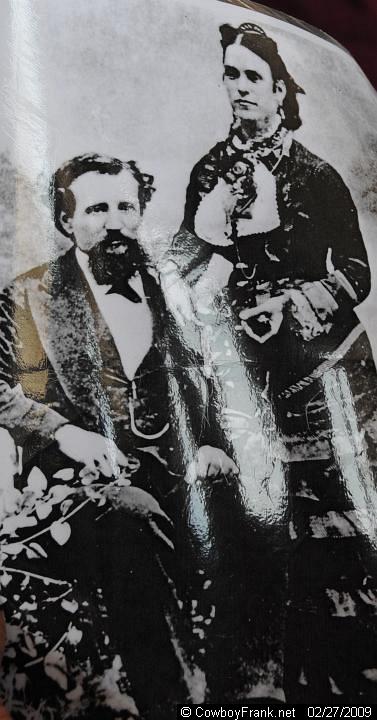
In 1881 Aaron Winters, a prospector who lived in Ash Meadows with his wife, Rosie, offered a night's lodging to a stranger, Henry Spiller, who was prospecting through the desert. His hospitality was well rewarded. The stranger spoke of the growing interest in the mineral borax and showed him samples of cottonball. One look told Winters that he saw the same crystals every day, covering acre upon acre of the floor of Death Valley.
The next morning, as soon as his visitor had left, he rode off to the valley, scooped up a bagful of cottonball and rode back to Ash Meadows. The stranger had told him about the test for borax: pour alcohol and sulfuric acid over the ore and ignite it. If it burns green, it's borax. At sundown, Aaron and Rosie tried the test on the bagful of sample: "She burns green, Rosie", shouted Aaron, "We're rich, by God!"
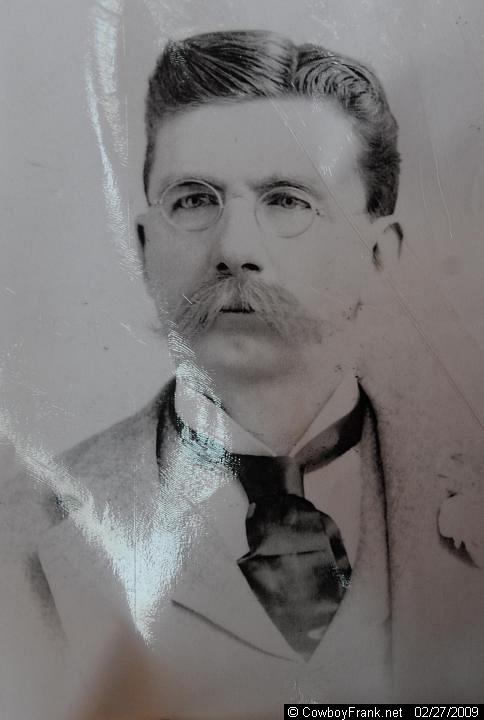
And they were. Winters sold the Death Valley acres he had quickly acquired to William T Coleman, a prominent San Francisco financier for $20,000.
Word of the valley's cottonball quickly spread. Daunet came back in 1882 and set up the Eagle Borax Works, but quit the business when he found that borax could not be processed by simple recrystallization during the intense summer heat. By the time operations could resume in the fall, the price of borax had fallen and he was never able to make the operation profitable.
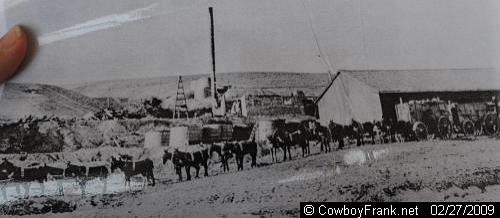
In 1882 Coleman built the Harmony Borax Works, hiring Chinese laborers to scrape cottonball from the ancient lake bed for $1.50 per day. Finding that summer processing in the valley was indeed impossible, he built the Amargosa Borax Works near Shoshone, where the summers were cooler. The ruined remains of these three early borax plants still stand in the desert. The borax was hauled to the nearest railroad by the use of 20 Mule Teams hitched to ponderous wagons. Coleman was producing about 2 million pounds of borax per year from his Death Valley and Amargosa facilities.
In 1882 the Lee brothers discovered a new form of borax along Furnace Creek Wash. This new mineral was named colemanite after Coleman. A quartz-like ore, it demanded far more complex mining method than cottonball, but it was far richer in borax. Coleman added these borax deposits to his holdings, but he never developed them. His financial troubles in 1888 closed the Harmony Borax Works, and then never reopened.
In 1890 Coleman sold his properties to an energetic and successful borax prospector from Teel's Marsh named Francis Marion "Borax" Smith for $550,000 giving Smith a virtual monopoly on domestic borax production. Smith consolidated these properties with his own to create the Pacific Coast Borax Company.
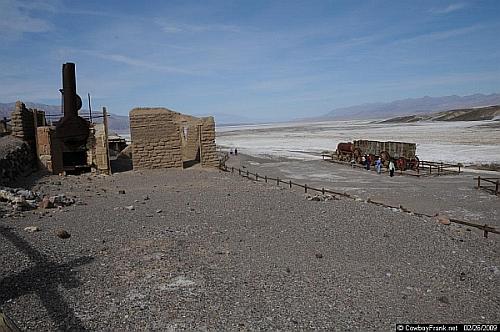
When the Harmony Borax Works was built in 1882, teams of eight and ten mules hauled the ore. But with increased production, the first teams of 20 mules were tried. Stretching out more than a hundred feet from the wagons, the great elongated teams immediately proved a dependable means of transportation.
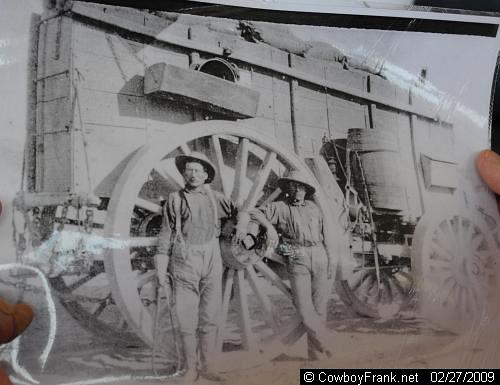 The borax wagons were large and well built. The rear wheels were 7 feet high, the front wheels 5 feet high. Each wheel had a steel tire 8 inches wide and an inch thick. The hubs were 18 inches in diameter and 22 inches long. The spokes were of split oak, the axletrees were solid steel bars. The wagon beds were 16 feet long and 6 feet deep, and could carry 10 tons of borax. Fully loaded, the wagons, including the water tank, weighed 36.5 tons.
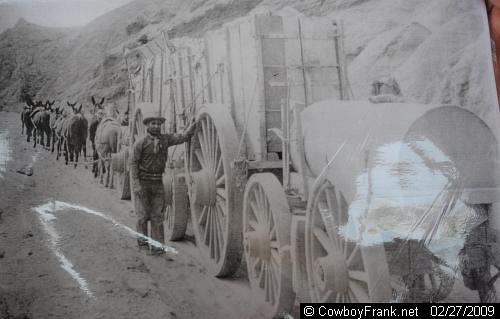
The distance to Mojave was 165 miles. Traveling fifteen to eighteen miles a day, it took ten days to make the trip. After leaving the valley the teams had to cross 100 miles of empty desert, where many of the overnight stops were at dry camps. Water tanks were therefore attached to the wagons, to supply the men and animals between springs.
Three men operated these 20 Mule Teams, in actuality eighteen mules and two horses. There was a driver who wielded a formidable whip; the teamster, who harnessed and unharnessed the mules, rode one of the horses, and handled the brake of the lead wagon; and the swamper, who rode on the rear wagon, operated its brake on the downgrades, and was chief cook and dishwasher.
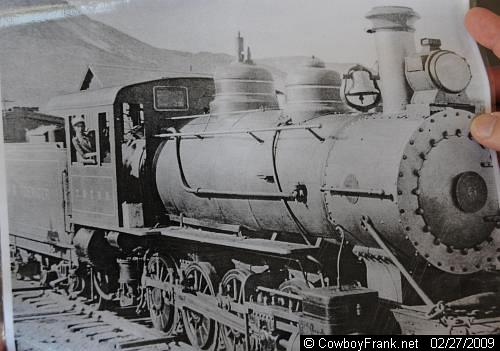
When borax was discovered in the Calico Mountains early in the 1890's, 20 Mule Teams hauled the ore from Borate to the railroad at Daggett. Except for the brief interlude when the traction engine "Old Dinah" attempted the job, borax was carried solely by these teams until the Borate & Daggett Railroad was built around 1895.
Among those who helped make the teams famous were J.W.S. Perry, PCB superintendent, who organized the first teams and mapped the routes; William Delameter, who constructed the wagons; Ed Stiles, driver of the first team; and teamsters Frank Tilton, Johnny O'Keefe and "Borax Bill" Parkinson.